Overview
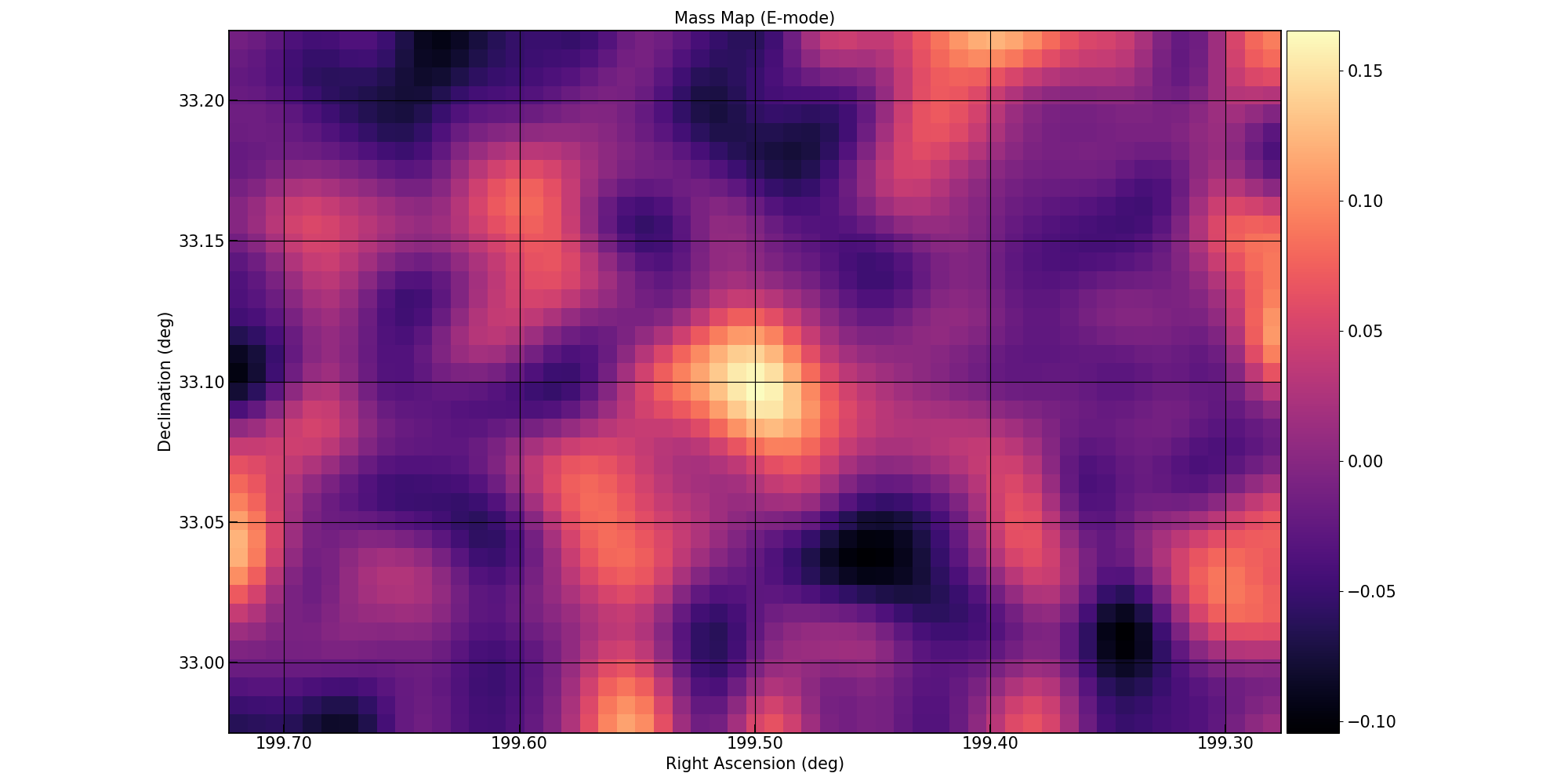
SMPy (Shear Mapping in Python) transforms weak lensing shear catalogs into convergence maps— potentially revealing the invisible dark matter distribution in galaxy clusters and cosmic structures. While mass mapping is essential for modern cosmology, researchers often implement these algorithms from scratch. SMPy provides a standardized, accessible, and robust solution with multiple reconstruction methods (Kaiser-Squires, aperture mass, Euclid’s KS+), flexible coordinate handling (celestial or pixel), and built-in statistical analysis. Originally developed for SuperBIT observations, it now serves as a general-purpose toolkit that makes publication-quality mass mapping as simple as writing a YAML configuration file.
Quickstart
See Installation for setup.
CLI (example config):
python runner.py -c smpy/configs/example_config.yaml
Python API (3 lines):
from smpy import api
result = api.map_kaiser_squires(data='examples/data/forecast_lum_annular.fits',
                                coord_system='radec', pixel_scale=0.4)
Expected inputs: a FITS catalog with shear components g1 and g2 (optional weight column), and coordinates in either RA/Dec (radec) or pixel (pixel) form.
Units: for RA/Dec, set resolution/pixel_scale in arcminutes per pixel; for pixel coordinates, provide a downsample_factor. Typical outputs (E- and B-mode maps, optional SNR maps, optional FITS) are written under <output_directory>/<method>/. For a full walkthrough, see Tutorials.
Methods at a glance
Kaiser–Squires (KS): the seminal inversion from shear to convergence; establishes a fast baseline (Kaiser & Squires, 1993).
KS+: an enhancement of KS that mitigates missing data and border effects and supports reduced-shear iterations (Pires et al., 2020).
Aperture Mass: localized mass mapping via tangential-shear filters (e.g., Schirmer/Schneider), useful for peak detection and compact structures.
What SMPy includes
Multiple methods (KS, KS+, Aperture Mass) for side-by-side comparison on the same data
Coordinate flexibility (RA/Dec or pixel) with automatic handling and gridding
Outputs: E/B-mode maps (B as a systematics diagnostic), optional SNR maps, plotting utilities, and optional FITS export for downstream use
Next steps: Tutorials, Configuration Guide, High-Level Interface.